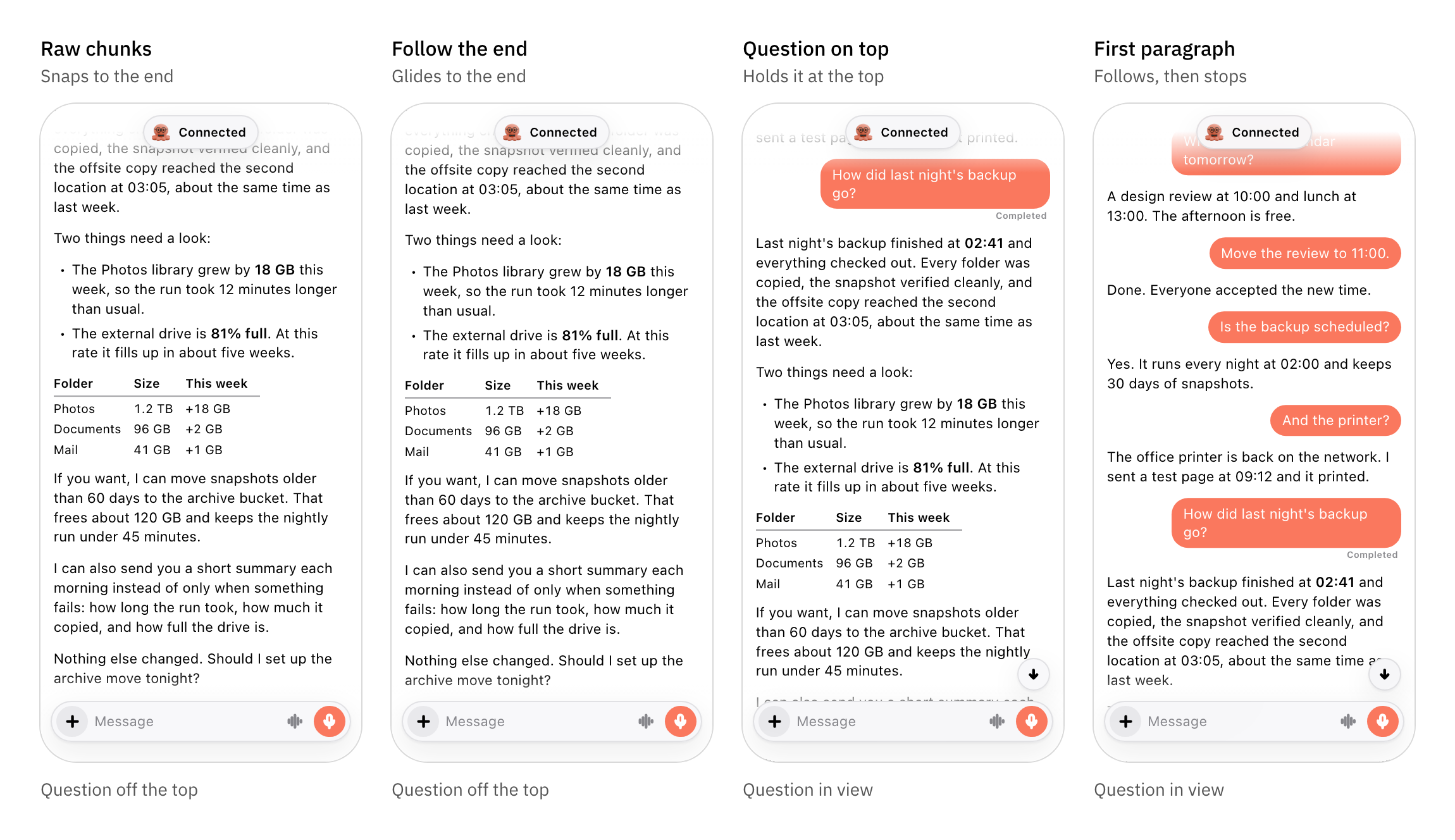
How Hank's reply view has changed to reduce jitter and unwanted scrolling.
Hank shows the agent’s reply while it’s being written. I’m trying to make long answers readable as they arrive, without jitter or scrolling that makes me lose my place.
The first build, on 2026-10-10, used bubbles on both sides, as in Messages. The narrow column cramped Hank’s headings, lists, tables, and code.
On 2026-10-13, I removed the bubble around his replies and gave them the full width; mine stayed in bubbles. Looser line spacing, modest headings, and a short hairline between consecutive replies kept his messages distinct.
Streaming brought another problem. Text arrived in bursts, unfinished Markdown flashed its asterisks and pipes, and the conversation jumped to the end several lines at a time.
On 2026-10-22, I changed how replies stream: whole words fade in over 0.28 s, paced 0.45 s behind their arrival. The renderer closes unfinished Markdown, as Vercel’s remend does, and holds tables until they’re complete. A continuous glide replaces the jumps, and my question moves to the top with the reply below it.
That reduced the jitter, but every message I sent still pushed the conversation to the top of the screen.
Then I modified the view to leave my bubble just above the composer. It followed Hank’s first paragraph, then stopped, keeping my question on screen. Automatic following resumed only when I scrolled to the bottom or used the jump button. Pacing adapted to the rate at which text arrived, and the same change smoothed streaming on the Mac.
Four Hank screens at the end of the same reply about last night's backup. Raw chunks and Follow the end have scrolled the question off the top. Question on top holds it under the header, with the rest of the reply below the fold. First paragraph stopped once the first paragraph was written, with the question still in view and the jump button for the rest.
Raw chunks
Snaps to the end
What's on my calendar tomorrow?
A design review at 10:00 and lunch at 13:00. The afternoon is free.
Move the review to 11:00.
Done. Everyone accepted the new time.
Is the backup scheduled?
Yes. It runs every night at 02:00 and keeps 30 days of snapshots.
And the printer?
The office printer is back on the network. I sent a test page at 09:12 and it printed.
How did last night's backup go?
Completed
Connected
Message
Question in view
Follow the end
Glides to the end
What's on my calendar tomorrow?
A design review at 10:00 and lunch at 13:00. The afternoon is free.
Move the review to 11:00.
Done. Everyone accepted the new time.
Is the backup scheduled?
Yes. It runs every night at 02:00 and keeps 30 days of snapshots.
And the printer?
The office printer is back on the network. I sent a test page at 09:12 and it printed.
How did last night's backup go?
Completed
Connected
Message
Question in view
Question on top
Holds it at the top
What's on my calendar tomorrow?
A design review at 10:00 and lunch at 13:00. The afternoon is free.
Move the review to 11:00.
Done. Everyone accepted the new time.
Is the backup scheduled?
Yes. It runs every night at 02:00 and keeps 30 days of snapshots.
And the printer?
The office printer is back on the network. I sent a test page at 09:12 and it printed.
How did last night's backup go?
Completed
Connected
Message
Question in view
First paragraph
Follows, then stops
What's on my calendar tomorrow?
A design review at 10:00 and lunch at 13:00. The afternoon is free.
Move the review to 11:00.
Done. Everyone accepted the new time.
Is the backup scheduled?
Yes. It runs every night at 02:00 and keeps 30 days of snapshots.
And the printer?
The office printer is back on the network. I sent a test page at 09:12 and it printed.
How did last night's backup go?
Completed
Connected
Message
Question in view
One simulated reply, arriving in uneven bursts. Raw chunks shows each chunk as it lands and snaps to the end; the other three fade whole words in at Hank’s pace and differ only in where the view goes.One simulated reply, arriving in uneven bursts. Raw chunks shows each chunk as it lands and snaps to the end; the other three fade whole words in at Hank’s pace and differ only in where the view goes. Play it on the page.
The working rule is to let me start reading, then leave the pace to me. Reports from Open WebUI and OpenAI’s desktop apps describe the same problem: automatic scrolling carries the beginning of a long answer out of view.
The broader guidance supports keeping movement small. Google’s layout-shift guidance describes how unexpected shifts lose a reader’s place; Bartram, Ware, and Calvert’s motion study shows how movement draws attention, especially at the edge of vision; and Apple advises restraint with motion in frequent interactions. My aim is a short fade on new words, with the lines I’m already reading staying put.

 Connected