
· 027
Ambient Computing · Progress
The model can tell me what to measure next
I already recorded the model’s guesses on its objects. Now the studio’s dimensions, furniture, places, and lights live in one specification, and the recorded facts carry their source and status: measured, confirmed, taken from a product specification or the CAD drawing, derived, or estimated.
That makes the uncertainty useful. Running just facts lists the derived and estimated values: a list of things to check when I’m back in the studio with a tape measure. In the current build, that’s 116 of 179 recorded facts.
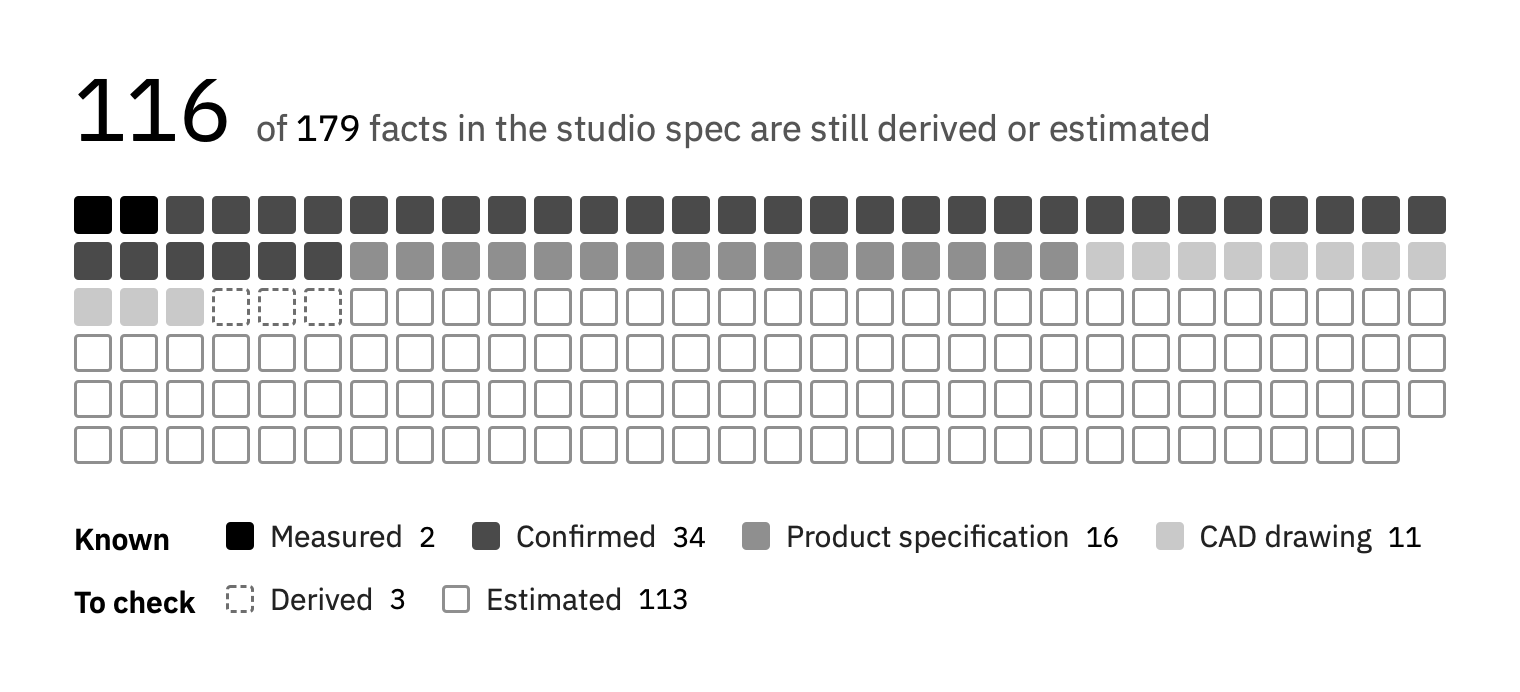
Every recorded fact as one square: 2 measured, 34 confirmed, 16 from product specifications, and 11 from the CAD drawing. The open ones are still derived or estimated.
The Tower is a good example. Its two columns have four and seven shelves; those counts are confirmed. The heights of the intermediate shelves are still estimates from a photograph. The model can look quite convincing while that distinction remains unresolved.
[units.SB]
name = "Tower"
# …
levels_a_m = { value = [0.15, 0.44, 0.73, 1.21], status = "estimated", source = "Count confirmed; heights from photos" }
levels_b_extra_m = { value = [1.55, 1.89, 2.23], status = "estimated", source = "Count confirmed; heights from photos" }
When I measure one, I can replace the estimate, record where the measurement came from, and rebuild. The model and the viewers follow the same specification. The next visit to the studio now comes with a checklist.